Offline transcription software: how should we handle business meetings?
Compare two offline transcription software building blocks and use an editable meeting-record template covering review, access, retention and deletion.
All postsYes, if recording is appropriate and the workflow has an owner for review, access and deletion. Treat audio and draft transcripts as temporary working material unless an agreed business purpose requires longer retention. Local processing alone does not establish those controls. For occasional or sensitive meetings, manual minutes may remain the better choice.
Which offline transcription software should we shortlist?
For a team building a controlled workflow, start by evaluating whisper.cpp and faster-whisper as transcription engines. They are developer building blocks, rather than complete meeting-record systems.
| Candidate | Documented starting point | Work to assess in your pilot |
|---|---|---|
| whisper.cpp | Local inference with CPU and Apple silicon support | Capture/import interface, model preparation, timestamps and actual hardware compatibility |
| faster-whisper | Python/CTranslate2 transcription with segment and optional word timestamps | Deployment dependencies, chosen CPU/GPU path and separately selected speaker-diarisation components |
| Manual minutes | Existing human process | Missed detail, review effort and whether a recording is needed at all |
The whisper.cpp licence and faster-whisper licence use MIT terms for their code; check the exact release, model and dependency terms for the package you deploy. These documented capabilities do not establish accuracy, an offline result or a software winner for your meetings.
If staff need a desktop application, assess the actual interface as another candidate. Check recording controls, export locations and administrative ownership as well as the speech engine. A wrapper can introduce network calls or storage behaviour that differs from the engine underneath it.
Use the editable meeting record and retention worksheet to compare candidates on the same agreed recordings. Record correction time and wrong action owners alongside transcription accuracy. Stage all required files, then test the full workflow with outbound access blocked before calling it offline.
Which meetings should be recorded, and what notice and agreement are needed for the actual setting?
Select meeting types before selecting a model. Routine operational meetings with clear decisions are a reasonable pilot candidate; exclude sensitive personnel discussions and other unsuitable sessions until the responsible owners have assessed them.
For the pilot, require informed agreement from every participant before recording. Explain the purpose, processing location, who receives each record, correction process and retention rules. Provide manual minutes when someone declines, and pause for late arrivals. This is a proposed operating policy, not a statement that one consent rule covers every Australian meeting.
The OAIC’s guidance on commercially available AI discusses meeting transcription and recommends seeking consent as best practice given uncertainty about what may be discussed. It also distinguishes notification from consent. Applicability of privacy, surveillance, workplace and sector requirements needs review for the actual participants and setting. A recording indicator does not settle that assessment.
Do not let the tool join every calendar event automatically. Give the organiser responsibility for starting, pausing and stopping capture, with a visible way for participants to request a pause. Document what happens if sensitive material is captured unexpectedly, including who decides whether it must be removed.
How do we transcribe locally while keeping speaker attribution and timestamps useful?
Use a local speech engine to produce a draft with source timings, then review who said what. A timestamp helps someone find evidence; it does not prove the words or speaker are correct.
The faster-whisper README at the reviewed commit documents segment and word timestamps and loading a converted model from a local directory. Named models can trigger downloads, so stage the required files before testing disconnected operation. The reviewed whisper.cpp README also documents local CPU execution and Apple silicon support. Neither source establishes performance on your meetings.
Separate transcription from speaker diarisation, which groups speech by speaker, and from assigning those groups to named people. The faster-whisper README lists separate diarisation integrations; it does not establish reliable participant identification by the base transcription engine. Keep uncertain labels anonymous until a reviewer resolves them. Preserve overlap and inaudible spans rather than inventing fluent speech.
Record the chosen runtime, model artefact, configuration and timestamp convention. Select and review any diarisation and summarisation components separately, including licences and dependencies. Keep the whole path within the agreed boundary: capture software, temporary files, logs, exports, backups and remote administration. Test outbound traffic; a local model file does not prove an offline workflow.
How should action items distinguish what was actually agreed from a model's inference?
Require every proposed action to point to the passage that supports it, and let the chair confirm its status. A useful draft distinguishes agreed, proposed, disputed and unclear items.
For each candidate action, show the wording, provisional owner, due date if stated, and source timestamps. Use “not stated” when a person or date is absent. Do not assign the nearest speaker as owner or turn “we could explore this” into an instruction to proceed. These are hypothetical failure cases for evaluation, not results from a tested system.
Review the whole discussion for later changes. An early suggestion may be rejected near the end; an extracted sentence cannot establish the final decision alone. The chair should reconcile the draft with participants before marking minutes approved. Record corrections and approval against an exact version.
Keep task creation and notifications outside the initial pilot. A reviewer may copy an approved action into the existing task system. Later automation would need its own authority and duplicate-prevention checks. A convincing summary is insufficient authorisation to assign work.
Who can correct the minutes and access the audio, transcript and summary?
Give each record an explicit audience. Participation in a meeting need not grant access to every later export, while an administrator’s technical access should not become routine browsing permission.
Propose a restricted working area for audio and draft transcripts, with access for the processing service and nominated reviewers. Let participants submit corrections through the agreed review process. The chair or designated approver resolves disputed wording and signs off the minutes; the records owner controls the approved record’s destination and retention.
Keep version history and access decisions without copying full transcripts into diagnostic logs. Disable broad sharing links and check search results, exports and direct file access against the same permissions. If different people can see different material, a summary must not expose restricted discussion through an easier route.
Test staff departure, incorrect group membership and an unauthorised direct request. Separate technical administration from content review where practical, and log exceptional access. These controls require application and storage configuration; they are not supplied simply by choosing a transcription library.
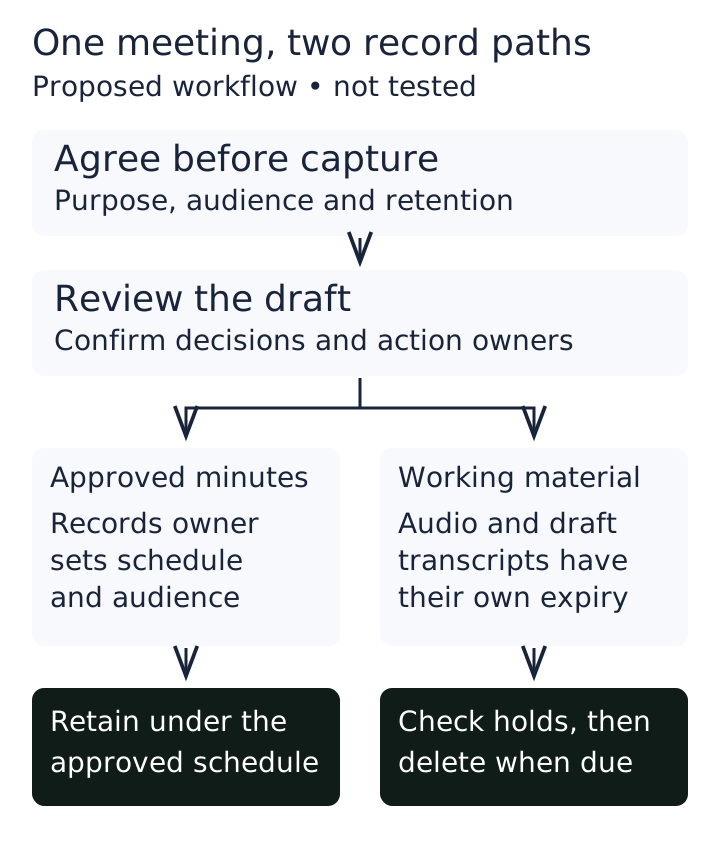
When should the recording be deleted while an approved business record is retained?
Set the deletion rule before capture, with an owner, trigger and exceptions. Approval of the minutes can be a useful trigger for reviewing temporary material, but it is not a universal legal deletion date.
For covered entities, APP 11 guidance requires reasonable steps to destroy or de-identify personal information no longer needed for a permitted purpose, subject to stated exceptions including certain legal retention requirements and Commonwealth records. Apply the organisation’s actual obligations and records schedule; do not substitute a generic seven-day rule.
Give audio, draft transcripts and approved minutes separate schedules. Resolve holds before expiry, escalate delayed approvals and document authorised extensions. Inventory temporary copies, indexes, downloads and backups. Test how expiry survives a restore, and describe any residual backup retention honestly. Deleting the visible recording is insufficient evidence that every copy has expired.
A searchable recording archive can be worthwhile when teams repeatedly need exact discussions. That is a fair countercase: establish its purpose, participant understanding, audience, correction process and retention period explicitly. If those benefits outweigh the burden, approve a controlled archive rather than allowing one to accumulate accidentally.
How do we test accents, noise, missing speakers and incorrect action owners before relying on the output?
Run a two-week pilot with staged, agreed recordings from one meeting type and a manual-minutes baseline. An operations owner defines expected decisions; technical and records owners manage access, expiry and rollback. Keep outputs as unapproved drafts throughout evaluation.
Include relevant accents, technical names, noise, overlapping voices, silence, missing audio, an absent speaker label and a withdrawn action. The Whisper large-v3 model card warns that predictions can include unspoken text and that performance varies across accents and dialects. Its general results do not establish accuracy in this setting.
Before running, agree acceptable review effort and accuracy criteria. Check every decision and action against the audio and reference minutes; count wrong owners, invented deadlines, omissions and unsupported actions separately. Report all evaluated meetings and actions as denominators. Stop expansion for a serious fabricated decision, unauthorised disclosure or failed expiry control; zero observed failures would not prove future safety.
Measure total capture, review, correction and administration time against manual minutes. Budget hardware, integration, storage, maintenance and records management; no cost advantage is established here. Test denied access, outbound connections, deletion and restore alongside transcription quality.
Rollback means stopping capture, disabling processing and returning to manual minutes while records owners handle existing material under the agreed rules. Proceed only if review effort and quality justify the ongoing work.