pgvector vs Pinecone: which fits our local AI search?
Compare pgvector vs Pinecone by deployment boundary, permissions and operating work, with a self-hosted Qdrant alternative and an editable test worksheet.
All postsPostgreSQL with pgvector is a credible starting point for a business that already operates PostgreSQL. Keep it if it meets the actual search and operating requirements. Add a dedicated store when a repeatable limit or a useful capability justifies the extra service and data copy.
The pgvector vs Pinecone decision starts with the permitted deployment boundary, then a matched retrieval comparison. A self-hosted Qdrant alternative is included for teams that must keep retrieval on-site.
pgvector vs Pinecone: what changes for a local AI workflow?
Choose pgvector when your approved design calls for PostgreSQL-based retrieval under your operating control. Consider Pinecone when a managed cloud retrieval service is acceptable and its operating model fits the workload. Neither is a measured performance winner here.
Pinecone's architecture guide describes its managed service on cloud infrastructure. Using it from a local answer model creates a cloud retrieval dependency. Review the vectors, metadata and any text you send; local generation does not make that retrieval path an on-site-only system.
| Decision | PostgreSQL with pgvector | Managed Pinecone service |
|---|---|---|
| Deployment boundary | Runs with your PostgreSQL deployment; assess that host and its dependencies | Cloud service; approve provider, destination and data handling |
| Operating responsibility | Your team/provider operates PostgreSQL, extension, capacity and recovery | Provider operates the service; your team still owns application access, ingestion and lifecycle design |
| Access design | Review application identity, database grants and row policies | Review application identity and trusted namespace/filter selection |
| Data changes | Keep source versions and access metadata consistent with the index | Propagate source updates, access changes and deletions into the service |
| Evidence needed | Same-corpus quality, restrictive filters, workload impact and restore | Same-corpus quality, restrictive filters, network delay and lifecycle behaviour |
The Pinecone multitenancy guide uses namespaces for tenant separation. Different staff in one tenant may still have different document rights; the application must enforce those separately. A namespace name supplied by a caller cannot establish authority.
Its deletion guide documents removal by ID, filter or namespace contents. That mechanism does not establish deletion of your application's exports, logs or backups. Test the complete lifecycle and record what remains.
Use the editable vector-store comparison worksheet to run a matched pgvector/Pinecone evaluation when cloud processing is approved. If on-site retrieval is a firm requirement, use the pgvector/self-hosted-Qdrant alternative below instead. The local alternative is a separate comparison, rather than evidence of Pinecone performance.
What document volume, update rate and filter requirements does our search have?
Describe the searchable passages and their use, rather than starting with a document-count threshold.
A vector represents content numerically so a search can compare similarity. Splitting documents into passages changes how many vectors the service stores. Record passage count, dimensions, text and metadata size, retained versions and expected growth.
Then describe the work: imports, ordinary updates, deletions, simultaneous searches and acceptable delay after a permission change. A quiet collection rebuilt monthly differs from a service changing throughout the day.
Filters deserve their own cases. A person may be allowed to search only one department or a few current documents. Test both broad and restrictive eligibility sets, including an empty set. An average across all staff can hide a poor result for one restricted group.
The pgvector v0.8.7 README explains that approximate-index filtering can leave too few results. Iterative scans can look further within configured limits. That makes filtered retrieval part of the comparison, rather than a feature tick.
No universal vector count or document count at which migration becomes necessary was established here. Agree the workload and acceptance conditions before choosing the database.
Can the PostgreSQL service we already maintain support retrieval?
Possibly, but existing skills do not establish spare capacity on the current production service.
pgvector documents exact search and the HNSW and IVFFlat approximate indexes. Approximate search exchanges some neighbour recall for speed. An exact reference tells you which nearby vectors an approximate method missed; it does not prove that those passages answer the business question.
Begin with that reference and human relevance judgements. Then test an approximate index if the workload needs it. Hold the corpus, embeddings and eligibility rules fixed while comparing results.
Measure the existing application's response times during retrieval, ingestion and index maintenance. Include CPU, memory and storage activity. A retrieval route that meets its own target can still be unacceptable if it disrupts order processing or another essential workload.
Another PostgreSQL instance is also an option to investigate when resource separation is the main concern. The choice is wider than adding search to the busiest transactional database or immediately adopting a different database product.
Confirm that the actual host supports the required extension and operating setup. A supported mechanism in documentation does not establish a working installation on a particular managed service.
When should we compare self-hosted Qdrant instead of Pinecone?
Choose the dedicated option when its capabilities or independent operation reduce the total work enough to justify another service.
For an on-site requirement, self-hosted Qdrant is a concrete alternative to test against pgvector. Its hybrid and multi-stage Query API can combine retrieval stages, including dense and sparse searches with result fusion. That may reduce application-side orchestration when the project needs those stages. It establishes no performance winner for this corpus.
The strongest countercase to keeping PostgreSQL is a retrieval-heavy application with frequent ranking changes and different scaling needs. Recreating useful search orchestration around SQL may cost more than operating a specialised service.
Compare that countercase fairly. First run a matched retrieval baseline. Then allow a feature-enabled variant, recording any extra ranking models, processing stages and maintenance. Otherwise a better result from an added reranker might be incorrectly attributed to the database alone.
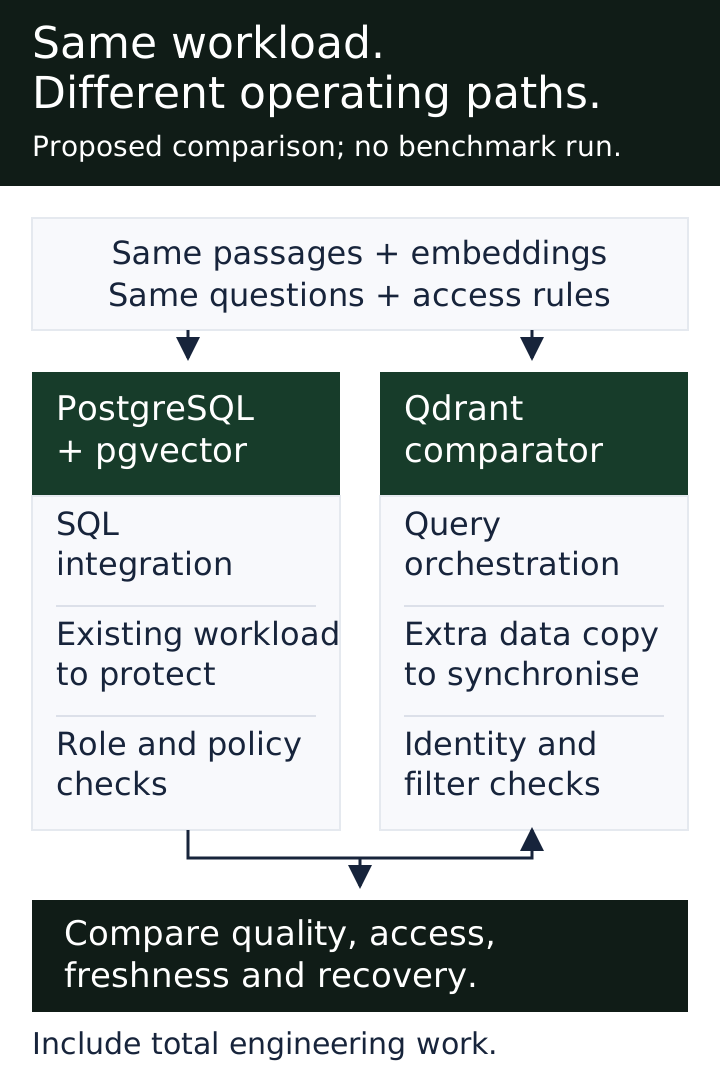
Ask which concrete application code, incident burden or tuning task the dedicated design removes. Also record the work it adds: data synchronisation, deletion handling, access-metadata updates, monitoring and recovery. Fewer custom queries can still mean more total operating work.
How do both options enforce access filters and recover from backup?
Both need an explicit identity and recovery design. A filter supplied by the caller cannot establish what that caller is authorised to read.
PostgreSQL 18 row security has important exceptions: superusers and roles with BYPASSRLS bypass policies, and table owners normally do too. Test the real application role and identity mapping. An administrator demonstration cannot establish ordinary-user isolation.
Qdrant's security documentation describes API keys and collection-scoped permissions. Those controls do not automatically reproduce every source document's access rules. The application must derive trusted constraints and prevent users bypassing them through direct store access.
Its self-hosted defaults also require security configuration. Local hosting alone establishes neither access protection nor a compliant workflow. Include embeddings, logs, diagnostics, backups, updates and optional cloud processing in the agreed data boundary.
For recovery, compare the complete application state. PostgreSQL documents several backup approaches, with different assumptions. Qdrant collection snapshots contain collection data and configuration, but exclude aliases and require attention to node scope.
Restore source versions, permissions, ingestion checkpoints and configuration coherently. Reconcile later deletions and access changes before reopening retrieval. A database backup alone cannot prove that this application recovers correctly.
What should a same-corpus comparison measure besides query latency?
Measure whether staff get useful permitted evidence and whether the team can keep the service working.
Choose one bounded prototype: pgvector versus Pinecone when cloud retrieval is approved, or pgvector versus self-hosted Qdrant for the on-site alternative. Use an approved read-only export and synthetic permission fixtures. Keep production writes, ERP changes and automatic external actions outside it.
Both candidates receive identical passages, embeddings, source versions and access metadata. Pin database, extension, client and model revisions. Record hardware, dimensions, index settings and resource allocation. Return ranked passages with source IDs; hold optional answer generation constant.
| Measure | Evidence the proposed comparison should retain |
|---|---|
| Useful retrieval | Human relevance judgements and approximate recall against a matched exact reference |
| Access | Actual user-role tests, restrictive filters, revocation and attempted bypass |
| Performance | Warm and cold response times, tail delays, timeouts and concurrent ingestion |
| Existing workload | Application response times and resource use against an agreed non-regression budget |
| Freshness | Observed update, deletion and permission-change delays |
| Recovery and upkeep | Isolated restore evidence plus setup, tuning, patching and incident effort |
Agree numerical quality, latency, freshness and recovery targets before the run. Require no unauthorised passages in the test cases, without treating a passing suite as proof against every attack.
The technical lead owns the comparison. Document owners approve relevance and access expectations; database operators own recovery checks. Stop a candidate after an access failure. If evidence is unavailable, return an unavailable result instead of generating an unsupported answer.
Rollback means disabling the prototype route and continuing with the existing search and source systems.
Which observed limit would justify migrating rather than adding another database immediately?
Migrate when a reproducible constraint remains after bounded tuning, or when a demonstrated capability reduces total engineering work.
Examples include unacceptable impact on the transactional workload, missed retrieval targets under required filters, or ranking changes that are materially easier to maintain elsewhere. Assign a tuning budget and decision date so the comparison does not become an indefinite rescue project.
Keep PostgreSQL if it meets the agreed requirements with acceptable operating effort. Choose the dedicated design if its measured advantage covers its additional integration and recovery burden. Neither conclusion follows from a database's category.
Compare incremental costs over the same period: capacity, power, storage, backups, integration, maintenance, security, recovery exercises and human evaluation. Actual prices, staff rates and measured savings remain unknown.
The documentation establishes viable mechanisms. It does not establish this deployment's capacity, offline behaviour, permission correctness, retrieval quality, recovery time or a winning store. Those are the results the prototype must supply.